Insights from Phuong Le, Partner at KLDP LLP, Hallie Schehter, Associate Attorney at KLDP LLP, and Jenny Zhan, Founder and CEO of Beyond International Group.
On April 3, 2026, Beyond International Group hosted a live webinar with KLDP — a firm with more than 5,000 EB-5 investor cases and $2.5 billion in EB-5 transactions — to unpack the filing strategy decisions that separate fast approvals from delayed or denied petitions. This article summarizes the key takeaways.
What Is the September 2026 EB-5 Grandfathering Deadline?
The EB-5 grandfathering deadline is September 30, 2026 — the date by which an I-526E petition must be properly filed to lock in current program terms under the EB-5 Reform and Integrity Act of 2022. Any petition filed on or before this date is protected from future changes to the EB-5 program, including potential expiration, investment threshold increases, or structural modifications.
As Phuong Le explained, this is effectively a contractual lock-in: in exchange for the $800,000 investment filed before the deadline, investors secure today’s program terms permanently. Given the current administration’s policy shifts — including proposed H-1B fee increases and new visa programs — grandfathering removes regulatory uncertainty from the equation.
With source of funds preparation alone taking 3 to 6 months, investors who begin now give themselves the runway to file before the deadline rather than scrambling to meet it.
How Does Rural TEA Priority Processing Affect EB-5 Filing Strategy?
Rural TEA (Targeted Employment Area) designation is the primary strategic lever in EB-5 filing today. Rural projects receive 20% reserved visa allocation, priority processing, and no visa backlog for any nationality. Le confirmed that rural petitions are currently being processed in the 6-to-8 month range, consistent with USCIS inventory management guidance that explicitly prioritizes rural and I-956F approved projects.
But faster processing creates a strategic obligation. Because USCIS wants to see full funding before approving a petition, Le advised that investors using partial funding strategies should plan to fund the remaining balance within 3 to 4 months. Faster processing is a double-edged sword — the timeline advantage only holds if your funding strategy keeps pace.
How Long Does EB-5 Source of Funds Preparation Take?
Source of funds is the longest component of EB-5 case preparation — typically 1.5 to 3 months — and the most common source of RFEs. Hallie Schehter identified a specific trend in current adjudications: commingled funds. Even when an investor’s $800,000 comes from straightforward W-2 income, USCIS wants to trace every dollar. Third-party transactions in the same account — Zelle payments, family gifts, transfers — trigger additional documentation requirements.
Le added that USCIS, under the current administration, is functioning more like an enforcement agency. New adjudicators without EB-5 experience tend to issue more RFEs because unfamiliar transactions look suspicious. Documentation clarity is more important than ever.
Six preparation steps:
1) Start source of funds first — before selecting a project. Get your documentation organized the way you’d get a mortgage pre-approval before house shopping.
2) Isolate your investment funds — minimize commingling by moving capital into a dedicated account early.
3) Prepare 7 years of tax returns — full 1040s with all attachments, not transcripts. IRS requests can take 45 days.
4) Create a funds flow diagram — a visual map showing how money moved across accounts helps your attorney and the USCIS adjudicator follow the narrative.
5) Schedule your medical exam early — availability and pricing will tighten as the September deadline approaches.
6) You do not need funds fully liquid to start — sourcing and verification can run in parallel with liquidity preparation.
Le’s framing: source of funds is “as much art as it is law.” The goal is to prove one lawful source of $800,000 as simply as possible, then close the door.
What Is the Difference Between an NCE Manager and a Regional Center?
The NCE Manager (New Commercial Enterprise Manager) is the entity that actually manages investor capital, negotiates with the JCE (Job Creating Entity), monitors construction, controls fund disbursements, and holds fiduciary responsibility. The Regional Center’s role is limited to immigration compliance and maintaining the USCIS designation. For a full breakdown, see The Risk of Overlooking the NCE Manager in EB-5 Due Diligence.
Jenny Zhan noted that investors in online forums often direct transparency complaints at the wrong entity — the regional center — when the NCE Manager is the one operating behind the scenes.
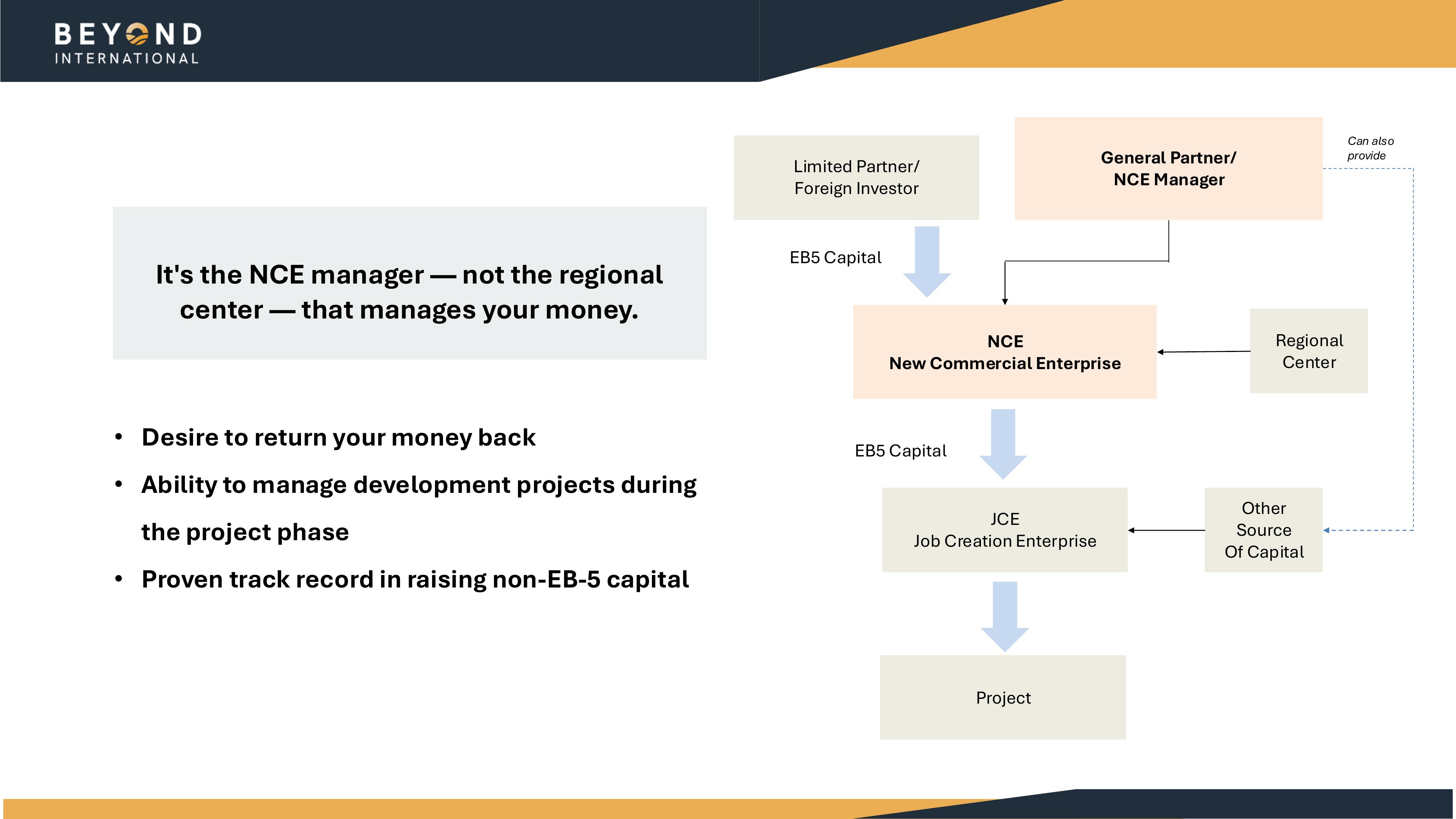
Three criteria define a strong NCE Manager:
1) Desire to return capital — the NCE Manager should not treat EB-5 as a one-shot business.
2) Ability to manage development projects — real estate investment experience, not just immigration process knowledge.
3) Proven track record raising non-EB-5 capital — signals institutional credibility and provides a structural backstop.
How Should EB-5 Investors Evaluate Real Estate Project Risk?
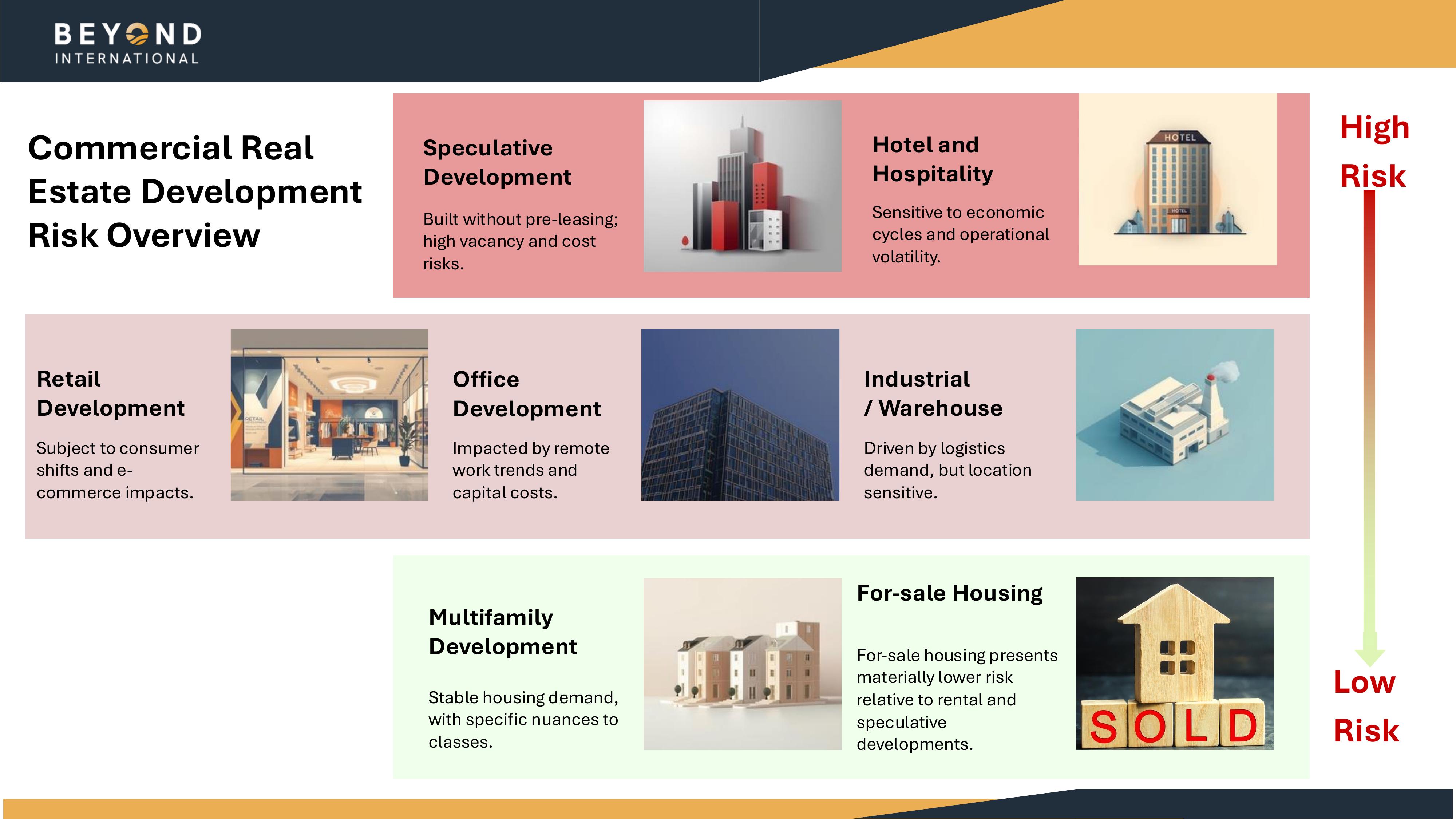
Zhan presented a risk framework mapping commercial real estate types from highest to lowest risk. Speculative developments and hotel/hospitality projects carry the greatest uncertainty. For-sale residential housing sits at the lowest end — units sell individually, cash returns are direct, and investors don’t wait for stabilized rental income. For a detailed evaluation guide, see Vetting Asset Class and Market Value in EB-5 Due Diligence.
Four layers of development risk to evaluate:
Regulatory risk: Is the project fully entitled and under construction?
Construction risk: Does the developer provide Completion and Maximum Cost Guarantees?
Financial risk: Does the project rely solely on EB-5 capital for completion?
Market risk: Is the exit price reasonable and supported by comparable sales data?
Beyond Paradise 1: A Rural EB-5 Filing Strategy in Practice
The webinar walked through Beyond Paradise 1 as a live example of aligned filing strategy. The project holds both I-956F approval and a confirmed I-526E approval in 7 months — validating the dual USCIS approval pathway.
Immigration Protections
1) I-956F approval: Filings enter the rural priority adjudication queue
2) I-526E denial refund: Capital returned within 3 months
3) Withdrawal provision: Capital returned within 6 months for any immigration withdrawal
4) Job creation: 41+ jobs per investor, 100+ jobs already created as of January 2026
Project and Capital Structure
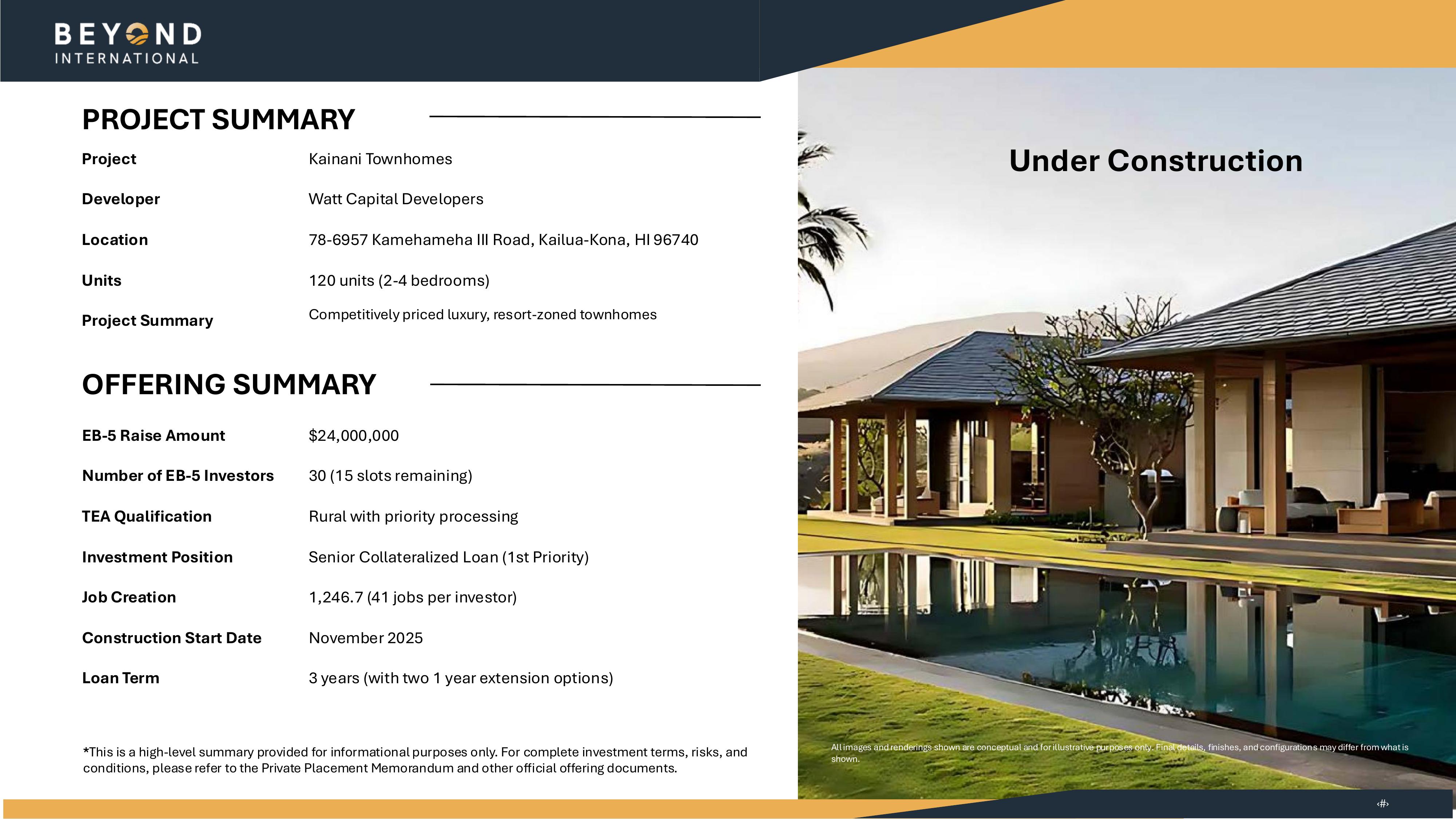
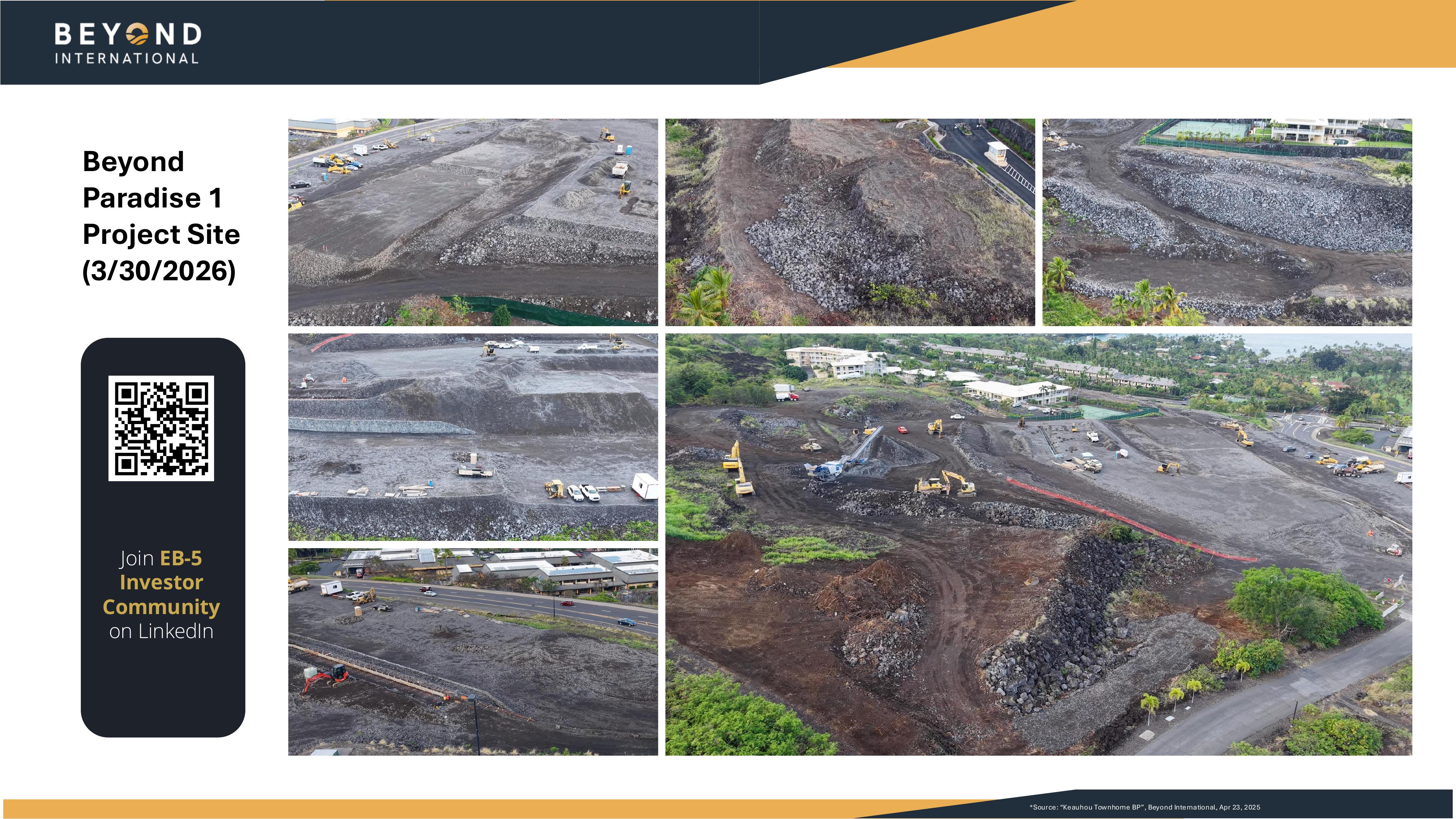
Kainani Townhomes: 120 for-sale townhomes on a 24.5-acre oceanfront site in Keauhou, Kailua-Kona, Big Island, Hawaii. Developed by Watt Capital Developers (77 years of experience, two prior resort communities in the same Kona area). Units range from 2–4 bedrooms, priced from $1.29M. Construction commenced September 2025; horizontal development substantially complete as of March 2026.
EB-5 capital of $24 million represents 13.7% of the $174.7 million total budget, structured as a senior collateralized loan in first-priority position with a recorded UCC financing statement, pledge agreement, and ownership certificate. The project includes Completion and Maximum Cost Guarantees. Over $20 million in bridge loan capital was committed before any EB-5 dollars were deployed. Rural TEA designation with reserved visas currently current for all nationalities. No admin fees for direct investors.
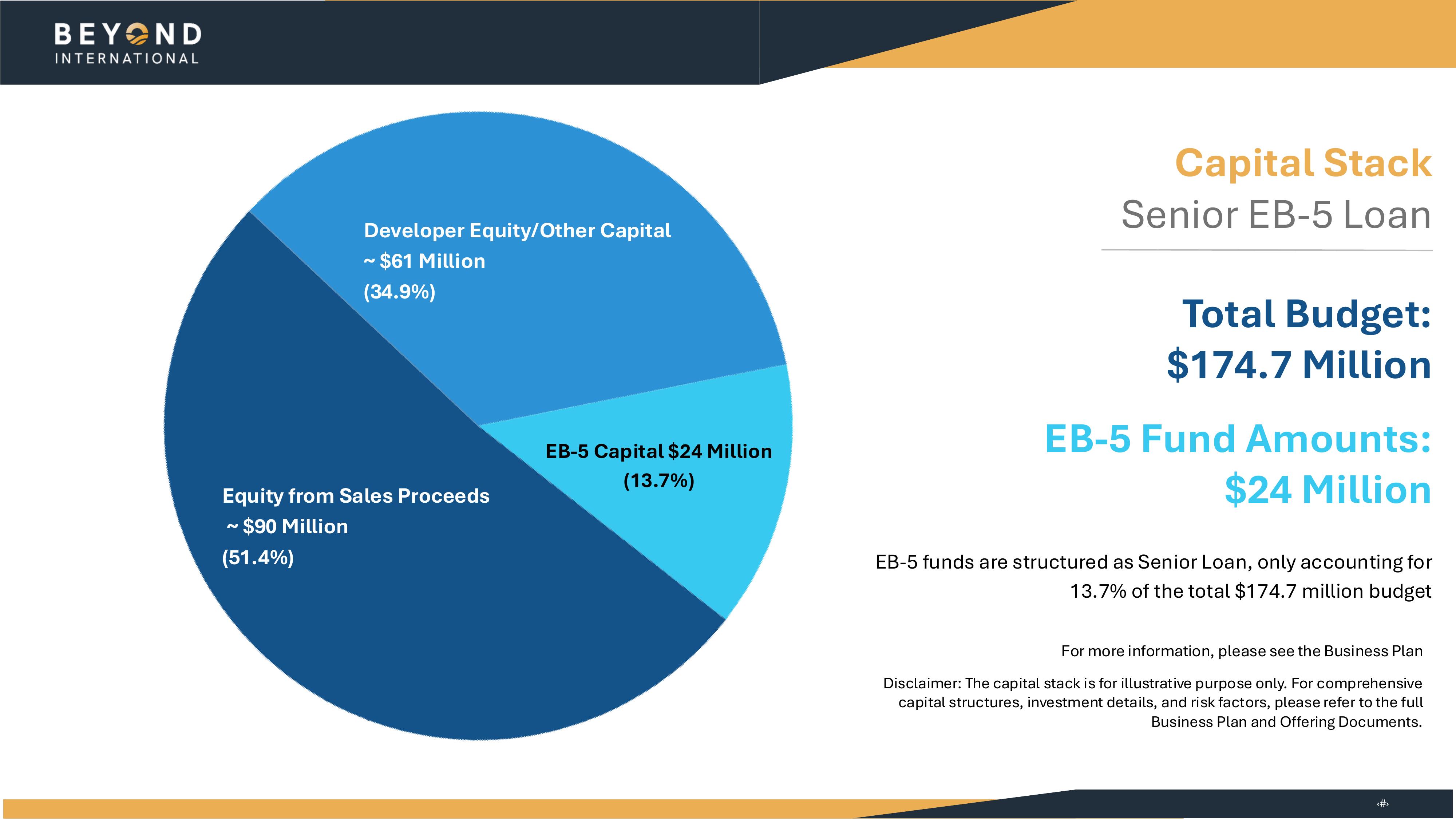
Phuong Le reinforced a critical nuance during the Q&A: many EB-5 projects market a “senior loan” that is contingent on raising the full amount. Beyond Paradise 1’s position is recorded and enforceable. The test is simple: ask whether the project has a recorded UCC lien on the collateral. If yes, the senior position is real.
Ready to Discuss Your EB-5 Options?
With fewer than 6 months before the September 30, 2026 grandfathering deadline, the filing window is narrowing. For investors who want to secure today’s program terms and take advantage of rural EB-5 priority processing, the time to begin source of funds preparation is now.